Bone Health for Female Runners: The Warning Signs That Show Up Before the Stress Fracture

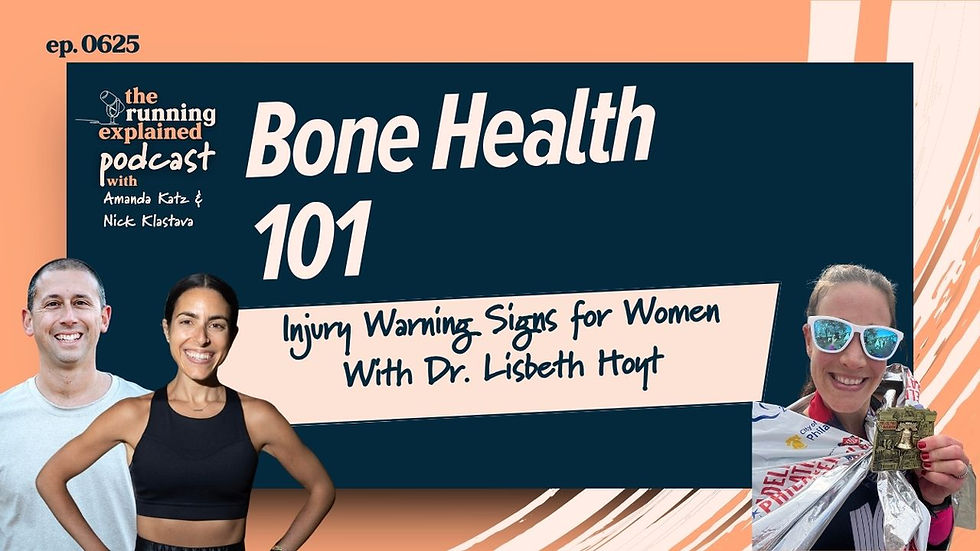
Episode: S6E25 | Guest: Dr. Lisbeth Hoyt, PT, Custom Performance NYC | Aired August 20, 2026 | 54 min
Author: Nick Klastava
Podcast Hosts: Nick Klastava & Amanda Katz
Listen: Spotify | Apple Podcasts | YouTube
Most runners do not think about their bones until one of them stops cooperating. That is usually the point where a stress reaction has already become a stress fracture and a two week problem has turned into a twelve week problem. In this episode, Coach Amanda and I sat down with Dr. Lisbeth Hoyt, a physical therapist at Custom Performance in Midtown Manhattan who is coming up on ten years there, to talk about how bone actually works, what she looks for in an intake form before an athlete even walks through the door, and the specific windows in a woman’s life where bone health needs a lot more attention than it usually gets.
Key Takeaways
• Bone is a dynamic tissue that breaks down and rebuilds every day. Running is a good stress that helps it rebuild stronger, as long as fuel and recovery are there to support it.
• Peak bone mass is built in childhood and adolescence and reached in early adulthood. Under-fueling, delayed puberty, and amenorrhea during those years all affect it, though nothing about that is permanently locked in.
• The first warning sign of a bone stress injury is not pain. It is run after run after run that feels like dragging through mud when the weather does not explain it.
• Early bony pain has a pattern: one specific spot that feels off during the run, goes away when you stop, and comes right back on the next run.
• Sleep and nutrition are the two biggest red flags Dr. Hoyt looks for on an intake form. Your body does not distinguish between good stress and bad stress, and cortisol spikes the same way for both.
• Estrogen is what maintains bone formation and remodeling, so any big hormonal shift raises risk. Postpartum, breastfeeding, perimenopause, menopause, and even an egg freezing cycle all qualify.
• A running specialized PT will keep you running in some form for almost everything except suspected bone stress, because removing running removes the information needed to fix the problem.
• The three things that protect your bones long term are strength training, adequate fuel, and sleep. All three are boring. All three work.
Bone Health Starts Long Before You Call Yourself a Runner
Bone is not a static structure holding you up. It breaks down and rebuilds every single day in response to what you ask of it, and running is a good stress in that equation. Load the bone, it rebuilds stronger. The catch is that the most important window for building bone happens well before most people start training seriously. Childhood and adolescence are when bone mass is developed, and peak bone mass is reached in early adulthood. Inadequate nutrition, delayed puberty, amenorrhea, and heavy training loads in any youth sport can all interfere with that development if the balance is not there.
Before anyone spirals about a middle school soccer season, Dr. Hoyt was clear that this is not an irreversible thing. What you build early is the starting balance and what you do in your twenties, thirties, and forties is the maintenance. The nutrition piece at that young age is also simpler than people expect. It is not eat this and avoid that. It is eat enough to support what you are doing while you are still growing. Have the snack after practice, get protein in, and build habits that carry into adulthood.
This is also where the research problem shows up. So many training studies were run on male subjects, and the findings get repeated as universal truth long after the sample gets stripped out of the conversation. Dr. Stacy Sims has built her whole premise around women not being small men, and she is right that the guidance needs to be different. Women go through significant hormonal shifts across the month that change how the body responds to stress, and that is exactly why bone health deserves its own conversation for female runners rather than a footnote in someone else’s study.
The Bone Health for Female Runners Warning Sign That Shows Up Before the Pain
The first thing Dr. Hoyt looks for is not an ache at all. It is perceived effort. If every run feels like a grind, if you are forcing yourself through mud and nothing is clicking, that is the earliest signal that something is off. She was careful to separate that from the obvious stuff. It is a hundred degrees and humid in New York City in August, and those runs make everyone question their fitness. What matters is run after run after run feeling like you are dragging when the conditions do not explain it. That usually means you are not recovering, not fueling, or not sleeping.
Then the aches show up, and the early bony pain has a very recognizable pattern. It is low level enough that you would not describe it as painful. One specific spot just feels off, or tight, or wrong. It is worse at the start of the run, it improves as you warm up, it disappears when you stop, and it is right back there on the next run. That is the window where a PT wants to see you, because at that stage you might be looking at the very beginning of the bone stress continuum and coming back from that is far easier.
Wait longer and the pattern changes. The ache is there throughout the entire run, it stays after you stop, three days of rest makes it go away, and it returns the moment you start again. Now you are trending toward stress fracture territory. The honest complication is that running is hard and not every ache is a bone stress injury. What makes it clearer is stringing the timeline together. Three weeks of terrible runs followed by shin pain is a very different story than one bad run in awful weather followed by a shin that quiets down in two weeks.
Why a Good PT Keeps You Running
Somewhere along the line physical therapists became the bad guy, which is backwards. Dr. Hoyt sends people out for imaging nine times out of ten hoping to be wrong, because the best outcome is that it turns out to be nothing, or something small that costs two weeks instead of twelve. The bigger point is that a running specialized clinic is not going to shut you down as a default setting. Suspected bone stress is the one situation where she tells an athlete not to run until there is an image. Everything else gets modified rather than removed.
That modification might look like pulling the workouts out of a typical marathon week, keeping the easy miles, and trimming some mileage to see how the injury responds while strength work addresses the biggest deficit. The reason for keeping you running is diagnostic. Shutting a runner down almost always resolves pain, because you removed the stimulus. It does not tell you anything about why the pain started. She used tennis as the parallel: stop playing for three weeks and your shoulder will feel better, but you still have no idea what caused it or what to fix. Keeping you running is how a PT finds the threshold. Is it the workout, the hill repeats, the long run, or the volume?
Amanda raised the flip side of this, which a lot of runners have lived. You get a script from your doctor, you land at a clinic that is not running specialized, you get fifteen insurance covered minutes and a band, and then you try to go back to running with no bridge between rehab and training. Those PTs are often set up to fail by the model they work in, and some people do get real benefit from that care in the acute phase. It just frequently does not translate to a runner, which is why so many athletes end up at a running specialized clinic afterward asking what happened. Part of that is on us as athletes too. If you walk into your doctor’s office and describe yourself as someone who jogs occasionally, you are not going to get routed to running specific care. If you do not advocate for yourself, nobody else is going to do it for you.
Sleep and Nutrition Are the Red Flags She Reads First
The intake form at Custom Performance is long on purpose. You get an hour with a patient, so the questions do the work of narrowing down where that hour should go. It asks about sleep hours and also how you feel about your sleep. It asks about nutrition with space to elaborate, and whether you fill that space in is information on its own. Then it goes into the parts of life that nobody thinks of as running variables. What do you do for work? Are you at a desk from nine to five or working from 6 a.m. to midnight and squeezing a run into a schedule that has no room for it? Are you running through lunch and skipping the meal? Who is making your food? Do you have kids?
Dr. Hoyt has caught stress fractures off an intake form before the athlete walked through the door, either from one enormous red flag or several stacked together. Sleep and nutrition are consistently the two biggest, and not just for bone. The reason is cortisol. Your body does not know the difference between good stress and bad stress. Running, lifting, a divorce, a move, and four hours of sleep all spike it the same way. So four hours a night paired with your current mileage is a genuine problem, not a personality trait. Smaller stressors are not harmless either. Enough yellow flags stacked together add up to the same red flag and the same outcome.
The useful framing here is non-negotiables. If you are working three jobs and finishing grad school, those things are fixed. The running is the variable, and that might mean this is not the year for a marathon cycle. Everyone has a different tolerance for stress, so the honest question is what you are giving up to fit the run in, and whether it is making your life better or costing you more than it gives back.
The Hormonal Windows That Need Extra Attention
The high risk periods are not really about age. They are about big hormonal shifts, whatever the source. Adolescence and puberty, postpartum, and menopause are the three obvious ones, but Dr. Hoyt also pointed to something like an egg freezing cycle, which is a massive hormonal event even when the outcome is a happy one. Fertility doctors have gotten much better at working with athletes on training during those cycles, but it still belongs in the same category.
Estrogen is the reason. It maintains bone formation, breakdown, and remodeling, so low estrogen from any source raises bone stress injury risk. That includes low energy availability, which is why REDs keeps coming up on this show. If estrogen is deficient, training needs to be modified, full stop. Perimenopause is its own frustration because the research now suggests it can stretch across a decade with no clean line marking the start, and plenty of women are in it without obvious symptoms or a clear diagnosis. Studying hormone fluctuations properly means drawing blood every couple of days, which is expensive and rarely funded, so the science is behind where it should be.
Postpartum deserves its own warning label. Dr. Hoyt had two kids and chose to breastfeed, which added up to roughly five years of pregnancy and breastfeeding, and a DEXA scan showed low bone density. Not from running and not from under-eating. From feeding a human. Molly Huddle has talked at length about this, including the point that the calorie cost of breastfeeding is in the neighborhood of running a marathon a day. None of that means you cannot run. It means your fueling has to be far higher than you think it is, and it is worth having a sports dietitian tell you where the gaps are. Dr. Hoyt worked with one herself and found out she was wildly low on protein, which is a very common answer.
The return to running piece matters just as much. The six to eight week medical clearance is confirming that you healed, not that you are ready to train. Your muscles have lengthened, shortened, and weakened, you are sleep deprived, and current research points toward something like twelve weeks of strength training to support the run. Dr. Hoyt sends everyone to pelvic floor PT for an assessment regardless of how the baby was delivered, because the pelvic pressure was there either way. She still lets people run, usually as a run walk or another modification, as long as the sleep, fuel, and strength are lining up behind it. Some of that is deciding day by day. If the baby was up every hour, that is not the day for the long run. Take the bike or the walk. If you got a solid six hour stretch, go run.
Strength, Fuel, Sleep, and the Goldilocks Problem
Asked for the short list, Dr. Hoyt did not hesitate. Strength train, fuel properly, and sleep. Sleep is the free recovery tool, and nobody is charging you for it. Strength training is what lets your bones, tendons, and muscles hold up under the miles, and it needs to be heavier than most runners are lifting. Her words: put the ten pound dumbbell down and work your way up to twenty and beyond. Fueling covers the runs and also the other twenty two hours of the day.
She framed the balance as a Goldilocks problem, which is the clearest version of this I have heard. Run too much, eat too little, and sleep too little, and you get injured. Run too little and skip strength work while eating plenty, and you never get the positive bone loading adaptations either. The target is appropriate load, adequate fuel, and real recovery, and that combination works out about ninety percent of the time.
The part runners struggle with is that this is boring, so we treat it as optional and go chase the exciting one percent instead. Five hours of sleep and one gel on a long run become a badge of honor rather than a problem. Meanwhile the gap between seven and eight hours of sleep is one of the biggest performance levers available to you, and most runners are sitting at six. If you cannot line those three things up right now because of where you are in life, that is real and it is fine. It might just mean this is not the block to chase a PR. As Dr. Hoyt put it, comparing your schedule to someone else’s is useless when you have no idea what is happening outside their race results and their Strava. Control the three things you can control and the performance tends to follow.
Guest Bio
Dr. Lisbeth Hoyt is a physical therapist at Custom Performance in Midtown Manhattan, where she is approaching ten years of practice. She is also a certified run coach, a certified strength and conditioning specialist, and holds a certification in mat Pilates. She lives in Hoboken, New Jersey with her husband, two toddlers, and a dog, and describes herself as a fitness enthusiast rather than only a runner. You can find her at Custom Performance on 41st and Madison, by email at lisbeth@nycustompt.com or info@nycustompt.com, and on Instagram at @lisbethh.jennings. Custom Performance offers free phone consults if you want to find out whether it is the right fit.
Frequently Asked Questions
What are the early warning signs of a stress fracture in runners?
The earliest sign usually comes before any pain, in the form of run after run that feels unusually hard when the weather and your training do not explain it. The first bony symptom is typically low level pain in one specific spot that feels worse at the start of a run, improves as you warm up, disappears when you stop, and returns on the next run. Once the pain is present throughout the entire run and lingers after you stop, you are moving toward a stress fracture and need imaging.
Why do female runners get more bone stress injuries than male runners?
Estrogen plays a direct role in bone formation, breakdown, and remodeling, so any period of low estrogen raises the risk of bone stress injury. That includes hormonal transitions like adolescence, postpartum, breastfeeding, perimenopause, and menopause, as well as low estrogen caused by low energy availability. Most training research has also historically been conducted on male subjects, which means women have been given guidance built on data that did not include them.
Should I stop running if I have pain?
Not usually. A running specialized physical therapist will keep you running in some modified form for most injuries, because removing running removes the information needed to identify what caused the pain. The exception is suspected bone stress, where the recommendation is to stop running until imaging confirms what is going on.
How long after having a baby can I start running again?
Medical clearance at six to eight weeks postpartum confirms that you have healed, not that your body is ready for run training. Current guidance points toward roughly twelve weeks of strength training to support a return to running, along with a pelvic floor PT assessment regardless of delivery method. Running can often start earlier in a modified run walk format as long as sleep, fueling, and strength work are in place behind it.

$50
Product Title
Product Details goes here with the simple product description and more information can be seen by clicking the see more button. Product Details goes here with the simple product description and more information can be seen by clicking the see more button

$40
Product Title
Product Details goes here with the simple product description and more information can be seen by clicking the see more button. Product Details goes here with the simple product description and more information can be seen by clicking the see more button
$50
Product Title
Product Details goes here with the simple product description and more information can be seen by clicking the see more button. Product Details goes here with the simple product description and more information can be seen by clicking the see more button.
$50
Product Title
Product Details goes here with the simple product description and more information can be seen by clicking the see more button. Product Details goes here with the simple product description and more information can be seen by clicking the see more button.


Comments